
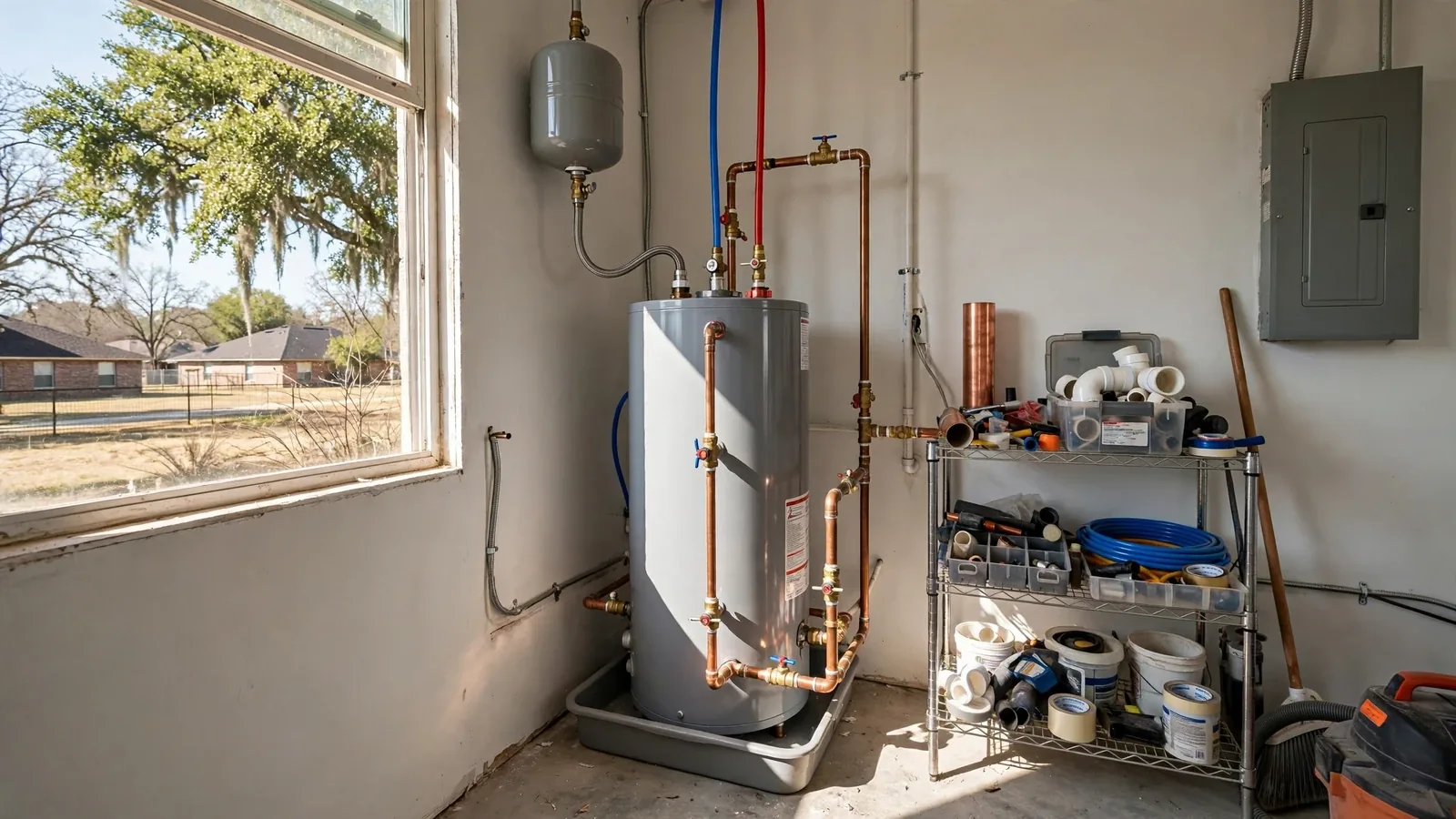
What Stow homes and Stow water mean for a new unit
Moderately hard city water
Stow's 2024 water quality report lists hardness at about 7 grains per gallon on average. Scale builds on elements, tank floors and tankless heat exchangers, so plan on a yearly flush whichever unit you choose.
Most homes date from the 1960s to the 1990s
Older Census data puts the median year built at 1980. Houses of that era often have a chimney flue sized for an older gas heater, which matters if you want to change the unit or the fuel.
Basements with floor drains
Many Stow homes keep the heater in a basement. A floor drain nearby makes a relief valve line and a condensate line easy, and a finished basement adds a reason for a drain pan.
City inspections and permits
The city lists plumbing systems among work needing a building permit. Ask the City of Stow Building Department what your project needs, since its pages do not state water heater rules.
Projects that call for a planned install
New home or addition
A new bathroom wing or second story can overload the old heater. Sizing the unit to the new fixture count avoids lukewarm showers.
Basement finish or relocation
Moving the heater to a closet or a different wall changes pipe runs, venting and the drain path. Plan these before drywall goes up.
Fuel change
Moving from gas to electric, or from electric to gas or a heat pump, changes the circuit, vent and gas line work.
Venting a chimney heater to the side wall
A new power vent or direct vent unit can exit through the side of the house and let you retire an old chimney connection.
Planning checklist before the install
- Location: choose a spot with floor space, a drain and a path wide enough to carry the tank in.
- Venting: confirm the flue size, or a fan or sealed vent route, and the clearance to combustibles.
- Gas line: check whether the existing pipe is large enough for the new burner's input rating.
- Electrical: confirm panel space and a 240 V circuit for electric and hybrid models, or a 120 V outlet for a power vent fan.
- Drain: plan the relief valve discharge pipe and a condensate line for condensing or heat pump units.
- Expansion tank: ask whether your supply setup needs one, since a closed system can trap thermal expansion.
Clearances matter more than most people expect. Manufacturers list how much space they need around the unit, above it for anode rod service, and in front of it for access. A good plan puts the heater where someone can reach the drain valve and the relief valve without moving a shelf.
Tank, hybrid or tankless: choosing the type
| Type | Strength | Watch for |
|---|---|---|
| Standard tank | Lower upfront cost, simple service | Standby heat loss, limited hot water in a long shower |
| Hybrid heat pump | Lower electricity use | Needs air space, a condensate drain and a 240 V circuit |
| Tankless gas | Endless hot water, small footprint | Bigger gas line, special vent, yearly descaling |
| Tankless electric | Compact, no venting | Large electrical load and panel capacity |
A tank fits when
- You want the simplest, most familiar equipment
- The gas line and vent are already in place
- Several fixtures run at once for short periods
- Budget and easy repair matter most
Tankless fits when
- You have a larger gas line or electrical capacity
- Space is tight and the tank footprint is a problem
- Hot water use is steady and long
- You will keep up with a yearly descaling flush
Tankless units have their own planning list, which we cover in detail on the tankless water heater page. If your old tank has already failed and you need a quick swap, the water heater replacement page covers that path instead.
Hard water and the equipment you choose
At about 7 grains per gallon, per the city's 2024 report, Stow's water is moderately hard. It will scale a tankless heat exchanger faster than softer water would, and it leaves crust on tank elements. A water softener is optional here, but it can reduce scale on whatever you install. Our page on softeners and filtration explains the trade-offs honestly, including when you can skip one.
Timeline and permit notes
A straight tank swap in an existing spot is often a same-day job. Moving the heater, adding venting or changing fuel takes longer, since gas, electrical and drain work have to line up. Ask for the plan and sequence before the visit.
Permit rules vary by job, so ask the City of Stow Building Department before work starts. Plumbing inspections are held Monday, Wednesday and Thursday mornings, and same-day requests must be called in before 9 am. The department's main line is 330-689-2729.
What to have ready for the visit
Data plate photo
Photograph the old heater's label for fuel, size, input rating and manufacture date.
Clear access path
Clear the stairs, doorway and the three feet around the unit so the tank can come in and out.
Panel and gas meter location
Know where the breaker panel and the gas shutoff are, and note any open slots in the panel.
Your wish list
Tell the plumber the household size, bath count and whether you want a tank, hybrid or tankless unit.
Planning a new water heater?
Call and describe the project. A dispatcher can arrange a visit with a licensed plumber, with same-day appointments when available.
If your project also includes new fixtures or a remodel, the plumber can look at the rest of the system during the same visit. See plumbing installation for related work. We also take calls from nearby Munroe Falls homeowners on the same line.
Ask whether the quote includes removal of the old unit, a drain pan and any permit handling, so you can compare quotes fairly.
QuestionsInstallation questions homeowners ask before they commit
A like-for-like tank swap is often a single visit. Changing the fuel, moving the unit or adding vent work takes longer. The plumber can give a plan for your job before work starts.
The city's pages do not state water heater rules, and permit rules vary by job. Ask the City of Stow Building Department before work starts. Plumbing inspections run Monday, Wednesday and Thursday mornings.
A tank is the simplest and often the lowest upfront cost. A hybrid heat pump saves electricity if you have the space. A tankless unit gives steady hot water but needs a bigger gas line or electrical load and a yearly descale.
Common spots are basements, utility closets and garages. The location needs access, a drain, clearance for service and, for gas units, a legal vent path. A plumber checks these before you buy equipment.
The city's 2024 report lists about 7 grains per gallon on average, which is moderately hard. Any heater will scale over time, tankless heat exchangers most noticeably. A yearly flush helps, and a softener is optional.
Often yes, if the panel has room for a dedicated 240 volt circuit and, for a heat pump, there is air space and a drain. The old vent may need to be capped. A plumber and an electrician can confirm what your home needs.
A photo of the old data plate, a clear path to the heater, a note of where the breaker panel and gas shutoff are, and your hot water needs. Ask whether removal of the old unit is included.