
Who is responsible for sewer service in Stow
The City of Stow does not provide or maintain sanitary sewer service. Residents contact the Summit County Department of Environmental Services at 330-926-2400, with an after-hours line at ext. 1. The city sends water meter reads to the county monthly, and the county bills sewer customers quarterly.
That quarterly sewer bill is a quick way to tell sewer from septic. A home that receives it is usually on public sewer. A home without it usually has a tank and a leach field instead.
What the county's backup page says
The county's page says backups caused by extreme weather, private lateral obstructions or non-flushable items are not a justifiable claim, under Ordinance 119A. The page does not say who owns the lateral. In practice, a clog in the home's own lateral is usually a plumber call first, and a plumber can tell you whether the blockage is private or in the county main. If the camera shows the blockage past your property line, call the county number above.
Septic homes in Stow: where a plumber stops and the tank company starts
Summit Public Health says about 33,000 homes in Summit County have septic systems, and Ohio's 2015 rules require every home septic system to hold an operation permit with routine maintenance. If your home has no quarterly county sewer bill, the backup might be a full tank or a stressed leach field instead of a clogged pipe.
A plumber can clear the line between the house and the tank and tell you whether the pipe or the tank is the trouble. Pumping a tank and judging the field are septic contractor and Summit Public Health matters, so ask them about permits and records.
SymptomsSigns the main sewer line is clogged
Floor drain gurgles or fills
The basement floor drain sits at the lowest point of the house, so it is the first to show a main-line blockage.
Toilet and tub act up together
A toilet that bubbles when the shower drains means one shared pipe is partly closed.
Washer drains into the floor
Gray water coming out of the standpipe or the laundry tub points past the branch line to the main.
Smell near the cleanout
A sewer smell in the basement or at the cleanout cap often means water is standing in the lateral.
Slow everywhere, not just one sink
Every fixture draining slowly, even the upstairs bathroom, is a stronger hint than any single slow sink.
Backup after rain
A line that fails only in wet weather may have a cracked joint, a root intrusion or extra water entering. See sewer line repair if the camera confirms damage.
Emergency sewage backup: what to do first
A sewage backup is urgent because the water carries bacteria and it keeps rising while the house keeps using water. Call the 24/7 line from a dry spot, and a dispatcher can arrange a same-day appointment when one is available or send a plumber after hours for the worst cases.
Safety steps before the plumber arrives
Stop using water everywhere: no flushing, showers, sinks, dishwasher or washer. Keep people and pets away from the wet area, and avoid standing in it. Turn off power to a flooded basement only if you can reach the breaker without stepping in water. Open a window for ventilation if the smell is strong, and do not run the furnace fan through the area.
Clear the cleanout
Move storage away from the capped pipe near the floor drain or the foundation wall.
Photograph the backup
Take pictures of the water level and affected areas for your own records and any insurance conversation.
Move valuables up
Lift boxes and electronics off the floor, but only from dry ground.
Note which fixtures failed
Tell the dispatcher which drains are slow, gurgling or full.
How main sewer lines are cleaned
| Tool | Used for | Limits |
|---|---|---|
| Large cable machine | Paper, rags, soft roots, general plugs | Leaves wall coating |
| Root cutter head | Roots at joints | Roots can regrow |
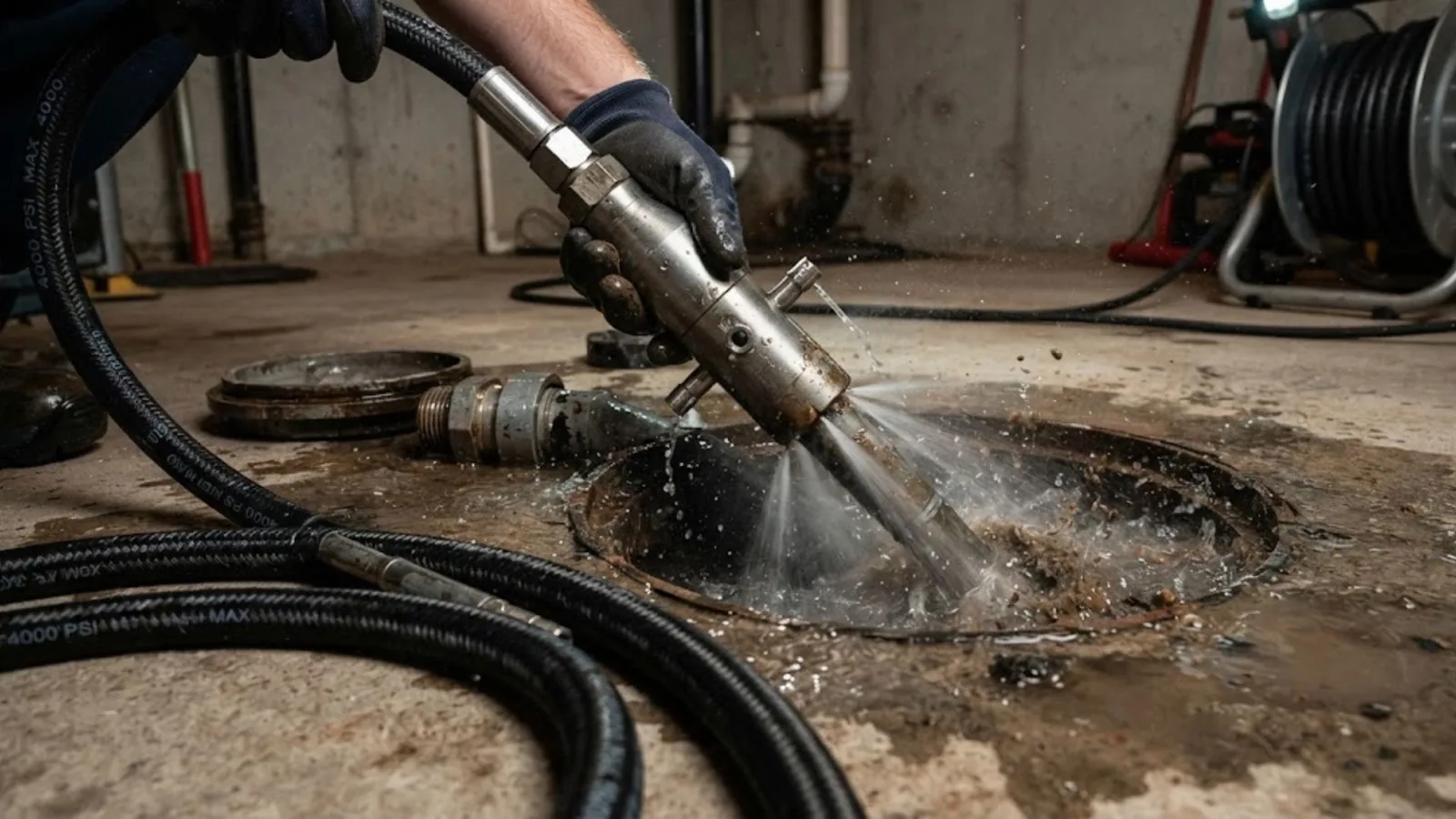
| Hydro jetter | Grease, scale, silt | Camera first, not for broken pipe |
| Sewer camera | Finding the cause and the location | Cannot clear a clog alone |
| Retrieval tool | Toys, wipes, objects | Needs a straight path |
Cleaning the line is enough when
- The camera shows a clog but the pipe is round and sound.
- The blockage was a one-time object or a wad of paper.
- Roots are light and the joint is tight.
- The line drains normally after the job.
Plan a repair when
- The pipe is cracked, collapsed or heavily offset.
- A belly holds standing water after every cleaning.
- Roots return within a few months from a failed joint.
- The backup returns on every heavy rain.
If the clog keeps returning and the pipe is sound, hydro jetting often fixes it better than a repeat cable pass. If the camera shows damage, a camera sewer inspection report is the starting point for repair.
Water coming up from a floor drain?
Stop using water and call the 24/7 line. A dispatcher arranges a licensed plumber.
Main line, sewer drain and lateral: the terms callers use
Callers describe the same pipe several ways: the main line, the sewer drain, the main sewer or the lateral. All mean the pipe from the house to the public main or the septic tank. The word main also names the county sewer main in the street, which is the county's to maintain.
This matters when you talk to the county. A backup that begins in your lateral is a different conversation from one in the county main.
Commercial sewer jobs usually need an on-site look first. The plumber states the price before the machine goes in.
QuestionsSewer backup questions answered for Stow households
The common causes are paper and wipes, grease, roots in a joint and a sagging section that holds water. Heavy rain can expose a weak joint, but the county says extreme weather is not a justifiable claim.
The county's page does not say who owns the lateral, and it says private lateral obstructions are not a justifiable claim. A plumber can tell whether the blockage is in your lateral or the county main.
Yes. The emergency line is open 24/7, and a dispatcher arranges a licensed plumber. Same-day appointments are offered when available. For a county main problem, the county's after-hours line is 330-926-2400 ext. 1.
If you get a quarterly sewer bill from Summit County, you are usually on public sewer. If not, you likely have a tank and leach field, and Summit Public Health can help with records.
Tank pumping and field inspection are done by septic contractors. A plumber clears the house side line and helps tell whether the problem is the pipe or the tank.
Wipes, even those labeled flushable, feminine products, paper towels, grease and floss. The county lists non-flushable items as a backup cause it does not accept as a claim.
The same dispatcher serves neighboring towns. See emergency plumber service in Hudson for coverage there.