
Urgent leak signs: what to do first
A leak is urgent when water is spreading faster than you can mop, when it is near light fixtures or outlets, or when a ceiling is bulging with trapped water. Sewage smell or gray water coming up through a floor drain also puts a leak in the urgent column. In those cases, call first and troubleshoot second.
The steps below stop the damage while a plumber is on the way. None of them needs a tool, and none of them makes the later search harder.
Immediate action while you wait
Close the main shut-off valve, usually on the basement wall where the supply pipe enters the house. Open one low faucet and one upstairs faucet to drain pressure out of the lines. Do not touch switches, outlets or appliances standing in water.
Turn off the breaker for that area only if the panel is dry and you can reach it without stepping through water. If you smell gas at any point, leave the building and call 911 or the gas utility from outside before you call a plumber.
Signs of a leak you cannot see
A bill that keeps creeping up
Usage that climbs month after month with the same household is a classic slow leak pattern.
Water sounds at night
Hissing or trickling when every tap is closed means water is moving somewhere it should not.
Warm or damp floor spots
A patch of floor that feels warm underfoot can sit above a hot line leaking into the slab.
Stains, bubbling paint or soft drywall
A brown ring on a ceiling or a wall that feels cool and spongy marks where water has been collecting.
What leaks look like in Stow homes
Pipe age by decade
Older Census data shows the median Stow home was built in 1980, with about 32% built from 1960 to 1979. Homes from that era often have galvanized or early copper lines that pit and pinhole, so a leak can be one of several weak spots.
Polybutylene years
Houses from the late 1970s through the mid 1990s may contain polybutylene supply pipe, a gray or blue plastic that was widely used and later phased out. If you see it, expect fittings to be the usual failure point.
Moderately hard water
The city's 2024 water quality report shows about 7 grains per gallon on average. Scale builds inside fittings and around faucet and valve seals, which is why a drip at an old shut-off valve is often the first leak a house gets.
Freeze and thaw winters
Northeast Ohio cycles through freezing and thawing all winter. Pipes in outside walls and garage ceilings flex and crack, then leak when the weather turns, so a spring leak may be a winter injury.
How a plumber pinpoints the leak
Good detection starts with questions, then narrows with instruments. Where is the stain, when did the bill change, does the sound come and go, and which fixtures run hot or cold when it appears? The answers decide which tool comes out of the truck first.
No single device finds everything. A plumber usually stacks two or three methods so one result confirms another before anyone cuts into a finished surface.
| Tool | What it finds | Works best on |
|---|---|---|
| Acoustic listening device | The hiss or vibration of pressurized water | Metal lines, floors, slabs, meter area |
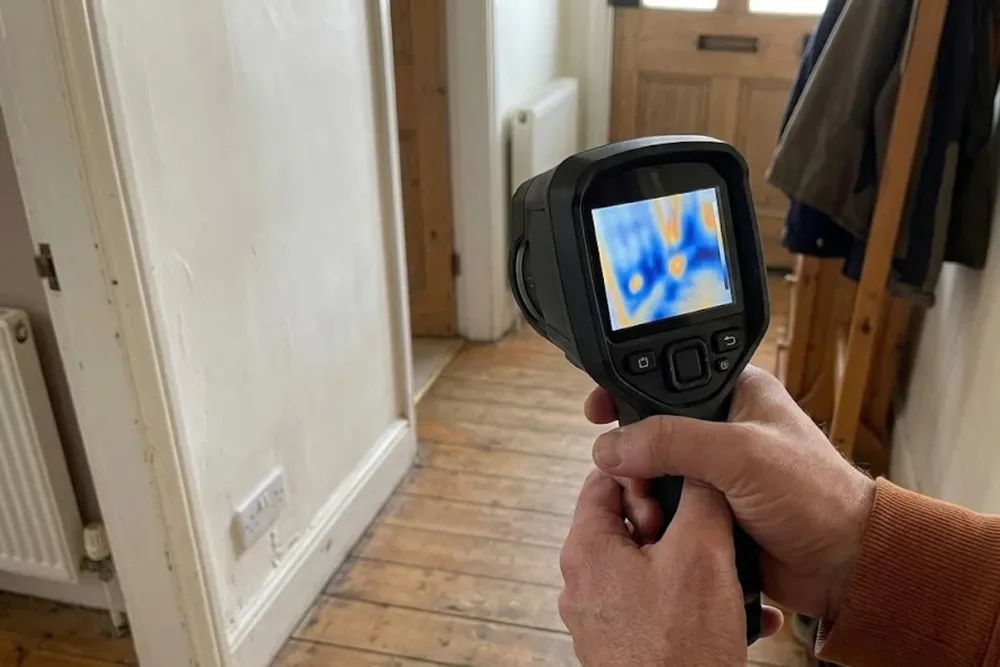
| Thermal imaging camera | Temperature differences from wet or hot-water leaks | Walls, ceilings, radiant and slab heat |
| Moisture meter | Dampness inside drywall, wood and subfloor | Confirming how far water has spread |
| Tracer gas | Gas escaping from a small hole in a sealed line | Plastic and buried lines that stay quiet |
| Pressure testing | Whether a section holds pressure or loses it | Isolating one run of supply or drain pipe |
High water bill: is it a leak or a read code?
Stow uses a radio-read water meter system that reports actual consumption, and the residential meters were replaced between 2003 and 2006. Your bill carries a read code: ACT means an actual read, EST means estimated, CRD means a customer read, and P means a postcard read. A sharp jump on a bill marked EST can be the city catching up on usage, not a new leak, so check that code before you start tearing into walls.
For scale, the city says a hose left running uses nearly 300 gallons an hour. A pinhole leak can waste a fraction of that around the clock, which is why it hides in a monthly total.
A meter test you can run at home
Stop every use of water
Close all taps, pause the dishwasher and washer, and turn off the ice maker and any irrigation timer. Skip toilet flushing during the test.
Find the meter and the leak indicator
Most meters have a small dial, triangle or star that turns with even slight flow. If it moves while the house is quiet, water is leaving somewhere.
Close the main valve inside the house
Watch the indicator again. If it stops, the leak is on the house side of the valve. If it keeps turning, the leak sits between the meter and that valve, or at the meter itself.
Write down what you saw
Note the meter reading, the time and the indicator behavior. Ask the Water Department at 330-689-2889 (Monday to Friday, 8:00 to 4:30) where its responsibility ends, then call us with your notes.
A running indicator with the main closed usually points to the buried line, which the water service line repair page covers in more detail. A stopped indicator sends the search inside the house, starting with toilets, water heater connections and the supply lines under sinks.
Meter still moving? Call now.
A dispatcher takes your address and arranges a licensed plumber. Same-day appointments when available.
Slab leaks: water under the floor
How a slab leak shows itself
When supply pipes run in or under a concrete floor, a pinhole there leaks without any visible puddle. The clues are a warm spot on tile or carpet, a water heater that seems to run constantly, damp baseboards, or the sound of running water with every fixture off.
A listening device picks up the pitch of water escaping, and a thermal camera shows the warm path of a hot line. Tracer gas or a pressure test then confirms the run, so the opening in the floor is as small as it can be.
Slab leaks are about more than the water. Moisture trapped under flooring grows mold and can undermine the slab, so a spreading damp spot is urgent even when the volume looks small. Fixes range from a spot repair through the floor to rerouting the line overhead, and a house with several failing runs may be a candidate for repiping instead.
Ceiling and wall leaks: tracing the stain upstairs
Water rarely drops straight down. It runs along a joist, a pipe or the back of drywall until it finds a low point, so the stain on your dining room ceiling can sit several feet from the actual drip. Treating the stain without tracing the water means the paint peels again by the next season.
A moisture meter maps the wet area, and a thermal camera shows where the cold or hot water moved through the cavity. The plumber then checks the likely sources above: a bathroom supply, a tub drain, a loose connection behind a shower valve, or a pipe that cracked in an exterior wall.
Under-house and crawlspace leaks
Not every house has a crawlspace, but many have an unfinished basement ceiling, an addition on piers or a low utility area where supply lines and drains hang in view. These spaces hide leaks because nobody looks up there. A running-water sound that seems to come from beneath the floor, a musty smell, sagging insulation or damp soil are the common signs.
The first job is telling a supply leak from a drain leak. Supply lines leak constantly under pressure, while drain lines leak only when something flows, often at a toilet flange or a tub trap. Pressure testing a section of supply pipe and running water through each drain in turn separates the two quickly, and a camera passed along a suspect drain can confirm cracks. See the sewer camera inspection page if the drain side is the concern.
Buried and underground line leaks
The water line from the meter to your house is out of sight, so leaks there show up as a soggy patch of lawn, a strip of unusually green grass in dry weather, pooling near the foundation or a drop in pressure. Plastic pipe is quiet, which makes listening devices less effective than they are on metal. For those lines, tracer gas and a pipe locator do much of the work.
Because a leak in the street or at the meter is the city's while the house side belongs to the owner, the first question is where the line crosses that boundary. The city's water main break emergency number is 330-689-5700. If the water is leaving between the meter and your foundation, our buried water line repair page explains your options.
Other places water hides
Irrigation and sprinkler leaks
A zone that stays muddy, a head that geysers, or a meter that moves when the system is the only thing on usually means a cracked valve, a failed lateral or a broken head. Isolating one zone at a time while watching the meter finds the guilty one.
Pool and spa leaks
Water loss in a pool can come from evaporation, the shell, or the plumbing around the pump. Pressure testing individual return and suction lines tells a plumber whether the pipes are at fault before anyone blames the liner.
Yard and meter-box leaks
Water bubbling in a meter pit or a wet spot by the curb stop needs a quick call. Do not dig or turn the city's valve yourself. Telling the Water Department what you see keeps the repair with the right crew.
After detection: repair options
Finding the leak is the diagnosis, and the fix is a different job with its own scope. Many leaks are small repairs at a fitting or valve. Others point to a pipe near the end of its life, and the honest advice is to say so before you pay for the same repair twice.
Spot repair makes sense when
- One leak, with pipe on either side in good shape
- The pipe is easy to reach without major demolition
- The line is newer or already partly replaced
- A pressure test shows the rest of the run holds
Reroute or replace when
- Several pinholes show up in the same stretch
- The pipe is corroded, brittle or an unreliable older plastic
- The leak sits under a slab and access is costly
- You have repaired the same line more than once
If a leak caused water damage, ask your insurer what written findings they want from the plumber before the visit, since a report with moisture readings and the leak location can support a claim. Commercial properties usually need an on-site look before anyone can say how long a search will take.
How a leak detection visit works
Call and describe
Tell the dispatcher the address, what you see and whether water is still moving. Tell them if you ran the meter test.
Plumber arrives and shuts off
The plumber confirms the main is closed, checks for electrical risk, and takes readings at the meter and fixtures.
Instruments narrow it down
Listening, thermal and moisture readings are layered until two methods agree on the same spot.
You get a plan and a price
The plumber explains what was found, shows where it is, and states a clear price before any repair work starts.
Leak detection questions from Stow homeowners
A plumber combines acoustic listening, thermal imaging, moisture readings, tracer gas and pressure tests to locate a leak without opening finished surfaces. You need it when you see damp or stains with no obvious source, hear water with everything off, or notice usage rising.
Check the read code first. Stow bills show ACT, EST, CRD or P, and a jump on an EST bill may be a billing estimate. Then run the meter test above, and if the leak indicator moves with every fixture closed, call for detection.
Yes. Our emergency line runs 24/7, including nights and weekends, and a dispatcher arranges a licensed plumber for active leaks, ceiling damage and meters that will not stop. Shut off the main valve while you wait if water is flowing.
Usually the search itself is non-invasive. Listening devices, thermal imaging and pressure tests locate the area before anything is cut. The repair may need an opening, or the line can be rerouted to avoid the slab.
Detection is the search, and repair is quoted as its own step. You get a clear price for the repair before work begins, so you can compare a spot fix with replacing the section.
Ask the Water Department where its responsibility ends. The city's office line is 330-689-2889, and the water main break number is 330-689-5700. Leaks on the house side are generally the owner's to fix.