
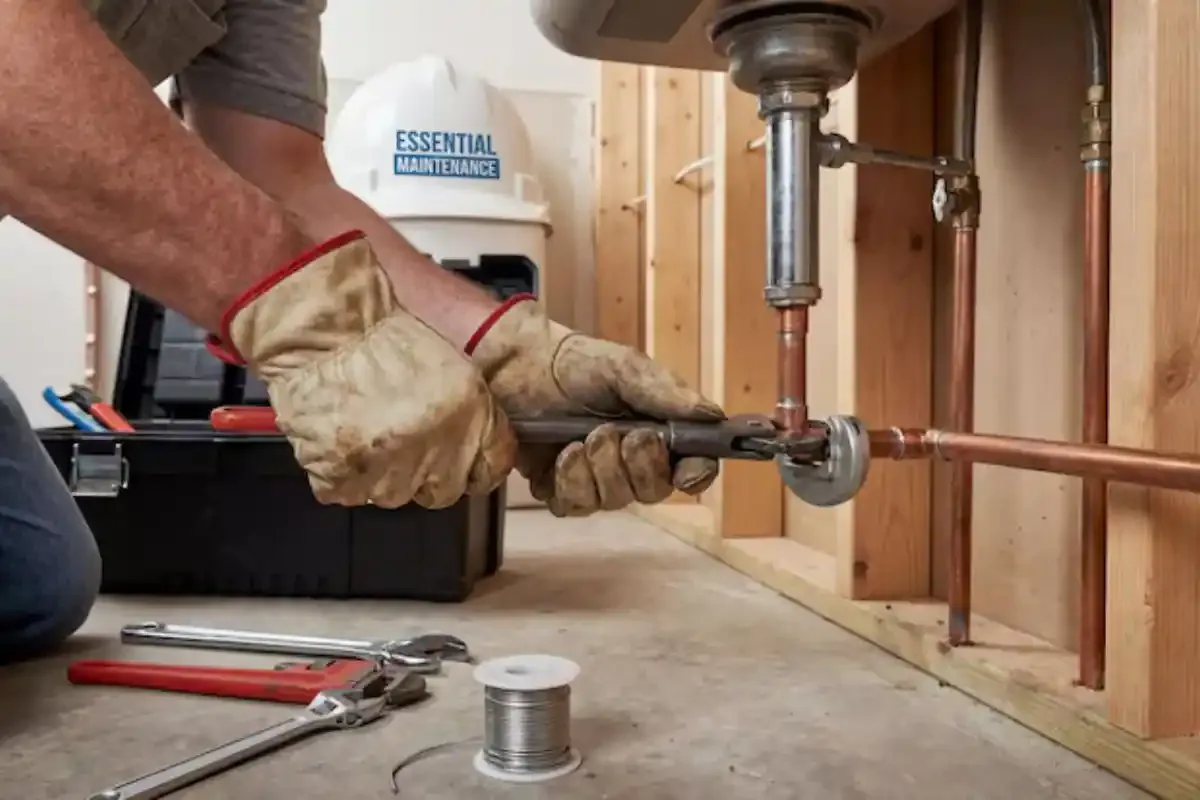
Burst pipe emergency: the first few minutes
A burst pipe is an emergency whenever water is escaping faster than a towel can catch it, whether it comes from a split in a basement line, a cracked elbow or a joint that let go inside a wall. Every minute of flow soaks more subfloor, drywall and insulation, and standing water near the panel raises the risk to people.
Work through the cards below in order. They need no tools, and they match what a plumber does first on arrival at a Stow house with a failed line.
Close the main valve
Turn the main shut-off clockwise until it stops. It is often on the basement wall where the supply pipe enters, near the meter.
Open taps to drain the lines
Open a cold tap on the lowest floor and one upstairs. With the main closed, this lets gravity empty the pipes and takes pressure off the break.
Mind the electricity
Stay out of rooms where water reaches outlets, cords or the panel. If the breaker box is dry and reachable, switch off the circuits serving the wet area. If not, leave it and tell the dispatcher.
Protect the water heater
If the supply is off for a while, turn off the heater's power at the breaker (electric) or set it to pilot or off (gas). A heater running without water can damage itself.
Gas and sewage safety
If you smell gas at any point, leave the building and call 911 or the gas utility from outside before calling a plumber. Do not use light switches or phones inside. If the water is dark or smells of sewage, treat it as contaminated and keep children and pets out.
How to tell a pipe has cracked or burst
Water where it should not be
A spreading wet spot on a ceiling, wall or basement floor that returns after you mop it up.
Sudden no-water or weak flow
Taps that sputter or run dry can mean a split upstream is draining the line.
Hissing or spraying sounds
A steady hiss behind a wall points to pressurized water escaping through a small crack.
Bulging or discolored drywall
A soft, bubbled patch with a yellow-brown edge means water has been collecting behind it.
A meter that spins after you close taps
If the dial moves while the house is quiet, water is leaving through a hidden break.
Rusty or cloudy water
Brown water from an older galvanized line can signal corrosion that is close to a failure.
Why pipes burst in Stow homes
Freezing is the best known cause, but it is not the only one. Corrosion thins the wall of a steel or galvanized pipe from the inside until the weakest spot gives way. A loose joint, a failed solder seam or a pipe pushed out of position by a settling floor can fail without any cold weather at all.
Older Census data shows the median Stow home was built in 1980, with roughly 18% of homes built before 1960. Homes from that era often have galvanized or early copper supply lines, and houses from the late 1970s through the mid 1990s may contain polybutylene. Knowing which you have tells a plumber whether the failure is a one-off or a sign of a pipe near the end of its life.
Water pressure and scale also play a part
The city's 2024 water quality report gives hardness of about 7 grains per gallon on average. Moderately hard water leaves scale that narrows pipe and stiffens valves, and a stiff valve that is forced to turn can crack the fitting behind it. A sudden pressure surge when a valve snaps shut hurts old joints more than steady pressure does.
Frozen pipes: what to do and why the thaw matters
Northeast Ohio winters cycle between freezing and thawing, and that cycle is the real danger to a pipe. Ice expands inside the line and can split it, but the split often stays plugged by ice and shows nothing until the temperature rises. The leak starts when the thaw arrives, sometimes while the family is out of the house.
If a tap runs slowly or not at all in cold weather, suspect a frozen section in an exterior wall, a garage ceiling or an unheated crawlspace. Leave that tap open a little, open cabinet doors under sinks to let room warmth reach the pipes, and warm the pipe slowly with a hair dryer on low or warm towels.
Never use an open flame
A torch or heat gun can ignite framing or insulation and can damage soft pipe. If you find a bulge, a frost-covered split or water as the ice melts, close the main valve and call. A pipe that has frozen once is a candidate for a closer inspection, because small cracks can hide until the next cold snap.
How a plumber finds the break
Sometimes the burst is obvious and sitting in plain view. When water turns up in a ceiling or a finished wall, the plumber tracks it with the same tools used in leak detection, so a small access opening is cut in the right spot instead of the wrong one.
| Where it shows | Likely cause | How it is checked |
|---|---|---|
| Basement joist bay | Frozen split or failed fitting | Visual check, then isolate with valves |
| Ceiling stain | Joint or crack in a supply above | Moisture meter and thermal camera |
| Exterior wall | Frozen section after a hard night | Thermal imaging, then small opening |
| Under a slab or yard | Corroded or cracked buried line | Listening device and pressure test |
| Behind a fixture | Cracked valve or elbow | Remove the escutcheon and inspect |
Repair options: patch, section replacement or something bigger
A section repair is enough when
- The damage is one split or one failed joint
- The pipe on both sides is sound
- The line is reachable through a small opening
- The material is common and easy to match
Plan a larger replacement when
- Pipe walls are thin or scaled along the run
- The same line has failed before
- The material is a known problem type
- Several breaks appear in one winter
If the failures keep coming, the honest advice is to look at a longer run of new pipe. The repiping page explains how a partial or whole-house replacement is planned, including what the walls and water shutoffs look like.
Copper, CPVC and PEX: how each one fails and gets fixed
Copper pipe repair
Copper bursts when ice splits the wall lengthwise or when a pinhole forms from pitting inside. A repair cuts out the damaged piece and sweats in a new section with fittings, or uses push-fit couplings where heat is a hazard. If the copper is thin and pitted along the run, patching it just moves the leak to the next weak spot.
CPVC and PEX notes
CPVC is rigid plastic that can turn brittle with age and crack at fittings, so a failure there often says something about the whole run. PEX is flexible and tolerates freezing better, but it is not immune, and it fails mostly at crimp or expansion fittings. Both are fixed with a matching repair coupling, and the plumber should tell you whether the pipe around the break is still sound.
Drain pipe repair
Drain pipes crack from age, shifting soil, roots or an old repair that gave way. Signs include slow drains, a sewer smell, damp soil at a cleanout or a wet spot along the drain path. A camera inspection shows the crack, and the fix ranges from replacing a short length of cast iron or PVC to relining a longer run. See our sewer camera inspection page for how that works.
Water still running? Call the 24/7 line.
A dispatcher takes your address and arranges a licensed plumber. Same-day appointments when available.
Water damage cleanup and drywall are separate from the plumbing repair. If you plan to file a claim, take photos before anything is moved and ask your insurer what they need. A commercial building usually needs an on-site look first, since the shutoff layout and pipe materials vary.
What happens on a burst pipe visit
Dispatch and confirm the shutoff
The dispatcher takes your address and tells the plumber what you have already done with the main valve.
Locate and isolate
The plumber finds the break, closes the nearest valves, and restores water to the rest of the house where possible.
Cut out and replace the damaged section
The plumber trims back to solid pipe and joins new material that matches the line.
Test and review
Water goes back on slowly, joints are checked under pressure, and you hear what to watch for before cleanup starts.
If water is leaking in the street or at the meter, that is the city's side. The water main break emergency line is 330-689-5700. We also serve neighbors in Munroe Falls with the same 24/7 line.
QuestionsBurst and cracked pipe questions
Close the main shut-off valve, open a low tap to drain the lines, and stay away from wet electrical areas. Then call the 24/7 line so a plumber can be arranged for the break.
A slow drip can wait a short time if you control it with a bucket and the shut-off at the fixture. A leak that wets drywall, a ceiling or electrical areas should be treated as urgent.
Yes. The emergency line runs 24/7, including nights and weekends. A dispatcher takes the address and arranges a licensed plumber, and you can shut off the main while you wait.
You can warm a pipe slowly with a hair dryer on low or warm towels while a tap stays open a little. Never use a torch or open flame. If you see a crack, bulge or water, close the main and call.
A single split in sound copper can be cut out and replaced with a short section. If the pipe is pitted or thin along its run, replacing a longer length makes more sense.
Look for slow drains, sewer odor and damp soil near a cleanout. A camera inspection shows the crack and where it sits, so repair can be limited to the damaged length.
That depends on your policy, so ask your insurer. Take photos before anything is moved, and keep the plumber's description of the cause and the repair for your claim.