
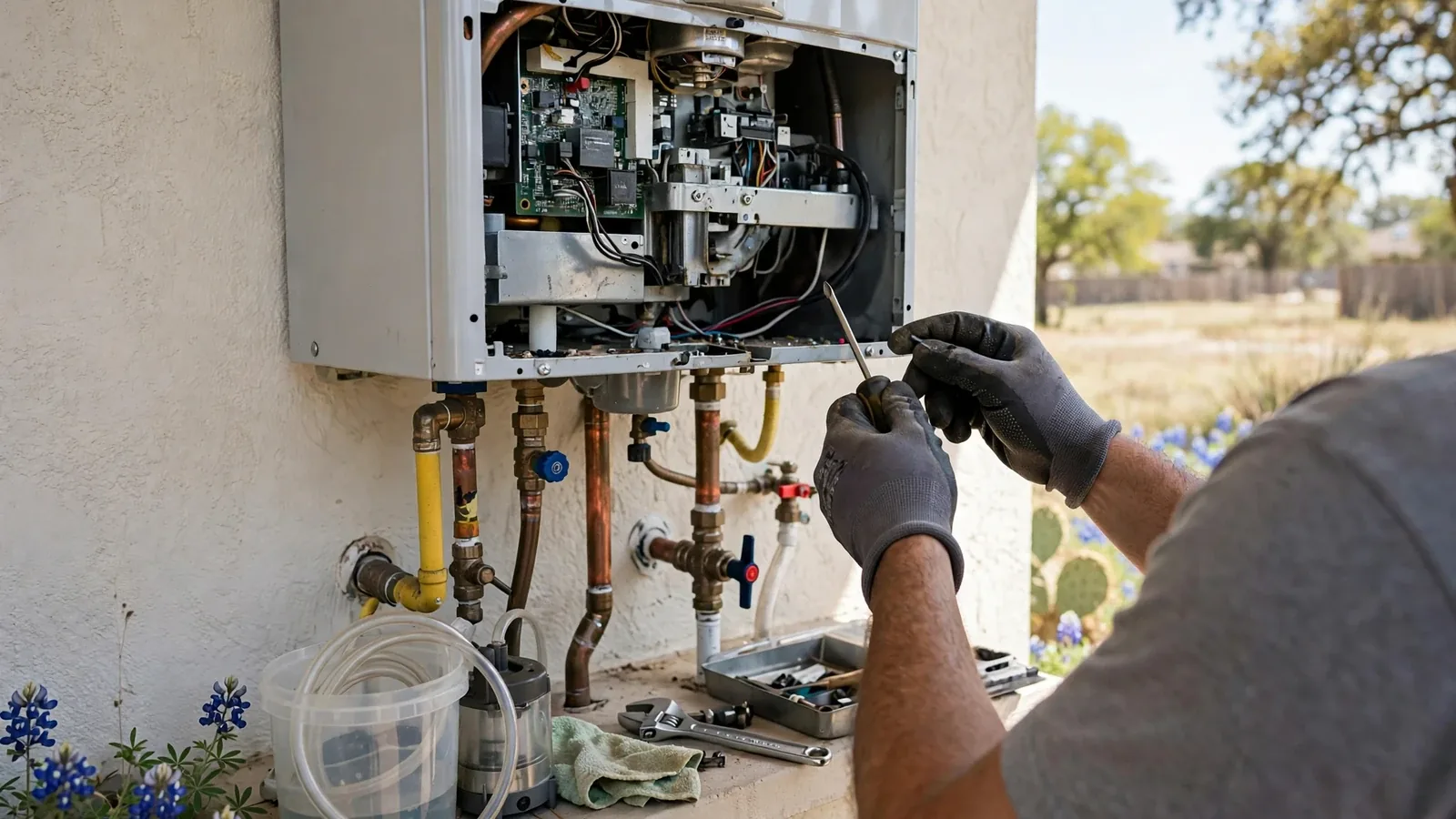
How a tankless service visit works
Read the unit and its history
The plumber checks the model, the display code, the flow and the age, and asks when it was last flushed.
Test flow, ignition and temperature
Gas units get a check of ignition, flame sensing, gas pressure and exhaust. Electric units are checked for element and thermistor faults.
Flush or repair
If scale is the problem, the unit is flushed. If a part has failed, you get a clear price for the repair before work starts.
Run, review and record
The plumber runs hot water at several flow rates, confirms the temperature, then explains what was found and when to flush again.
Flushing and descaling a tankless water heater
Stow's water averages about 7 grains per gallon, according to the city's 2024 water quality report. That is moderately hard, so minerals leave a scale film inside the heat exchanger every time water is heated. The film narrows the passages, reduces flow and makes the unit work harder.
A flush runs a cleaning solution through the heat exchanger. A plumber closes the isolation valves, connects hoses to the service ports and circulates white vinegar or a descaler approved by the manufacturer with a small pump for a set time. Then the unit is rinsed with clean water, and the inlet screen is cleaned. Using the wrong chemical can damage seals, so follow the manual.
How often depends on hardness and how much hot water you use. In water like Stow's, once a year is a common starting point, and a household with heavy use may want it sooner. Ask the manufacturer for its interval, and check your warranty terms, since some require documented flushing. If your unit has no service valves, the plumber can add them so future flushes are simple.
What to settle before a tankless installation
A tankless unit asks more of the house than a tank does. Gas models draw a high burst of gas, so the existing pipe may be too small. They need a sealed vent of stainless or PVC, depending on the model. Condensing models drain acidic condensate that needs a neutralizer and a drain.
- Gas line size: confirm the pipe can supply the unit's full input rating at its far end.
- Venting: pick a side wall or roof route and check clearances to windows and meters.
- Condensate drain: plan a neutralizer and a path to a floor drain for condensing models.
- Electrical: gas models need a 120 V outlet, and electric models need heavy circuits and panel room.
- Recirculation: a pump and return line, or a built-in recirculation mode, shortens the wait for hot water.
For the broader planning list, see our page on planned water heater installation, which also covers tank and hybrid choices. Permit rules vary by job, so ask the City of Stow Building Department before work starts.
Error codes and cold water sandwich problems
Ignition or flame codes
The unit tries to light and shuts down. A dirty flame sensor, low gas pressure or a failing igniter are common causes.
Exhaust or vent codes
A blocked, loose or undersized vent pipe, or a failing combustion fan, triggers a safety lockout.
Flow or temperature codes
Scale on the heat exchanger or a clogged inlet screen can starve the flow sensor and cause erratic temperatures.
Cold water sandwich
A burst of hot water, a cold slug, then hot again. It comes from short, repeated draws, and a recirculation setup or buffer tank can help.
Codes vary by brand, so check your manual for the code table and note the number before you call. If a code returns after a reset, the cause is still there. A plumber can read the fault and bring the right part, often a sensor, igniter or inlet screen.
Tankless water heater leaks and repairs
Most leaks start at a connection, such as an isolation valve, a union or the condensate line. A weeping drain on a condensing unit can also be a clogged neutralizer. A cracked heat exchanger is the serious case, and it often means replacing the unit.
Turn off the water supply and the gas or power if you see water at the base, and call. A tankless unit that is leaking inside the cabinet should not run.
Gas smell near the unit
If you smell gas, leave the building. Call 911 or the gas utility from outside before you call a plumber, and do not use switches or phones inside.
Tankless versus a tank: an honest comparison
Tankless works well when
- You can supply the gas pipe or electrical capacity
- Hot water use is long and steady, such as several showers in a row
- Wall space matters more than floor space
- You will flush it every year
A tank may suit better when
- The gas line or panel would need a costly upgrade
- Several fixtures run in short bursts
- You want lower upfront cost and simple repairs
- You rarely think about maintenance
Tankless units do not store hot water, so you are not paying to keep 40 gallons warm all day. They also do not solve a hardness problem. Scale builds in them faster than in a tank, and a failed exchanger can cost more to replace than a tank.
Why Stow's water and homes shape tankless decisions
| Local factor | What it means for you |
|---|---|
| About 7 grains per gallon (2024 city report) | Plan a yearly flush and check the inlet screen |
| Median home built 1980 (older Census data) | Gas pipe and flue may be sized for a tank heater |
| Brief pressure changes after hydrant flushing | Low flow codes after flushing may clear on their own |
| Cold winter inlet water | Peak flow is harder to meet in January, so size the unit for winter |
If scale is a worry, a whole-house softener can protect the heat exchanger, though Stow's hardness makes it a choice and not a necessity. We explain the options on the softener and filtration page. Tank-style units have their own faults, covered on the water heater repair page, and Cuyahoga Falls homeowners can call the same line.
Need a tankless flush or a repair?
Call and tell the dispatcher the brand, the code and when it was last flushed. A licensed plumber is arranged, with same-day appointments when available.
Commercial tankless systems usually need an on-site look before a plan is possible. Residential jobs can be priced after the plumber sees the unit.
QuestionsTankless flushing and service questions
Stow's water averages about 7 grains per gallon in the city's 2024 report, so scale builds steadily. Once a year is a common starting point, and heavy use may call for more. Ask the manufacturer for its interval and check your warranty.
The plumber closes the isolation valves, connects hoses and a small pump, and circulates white vinegar or a manufacturer-approved descaler through the heat exchanger. The unit is then rinsed and the inlet screen cleaned.
The meaning varies by brand. Most codes cover ignition, flame sensing, venting, flow or temperature sensors. Check your manual and give the code to the dispatcher before the visit.
That is called a cold water sandwich. It happens when you run hot water in short bursts and the line cools between draws. A recirculation line or a small buffer tank can reduce it.
It depends. Tankless units save floor space and give steady hot water, but they cost more up front and need a yearly flush. A tank is simpler and costs less to repair. See the comparison on this page.
Leaks at valves, unions or the condensate line are often repairable. A cracked heat exchanger usually means replacement. Turn off the water and power or gas and call a plumber.
Gas models need a larger gas line, a sealed vent and a condensate drain if they condense. Electric models need heavy circuits and panel room. A plumber can check your home before you buy.