
Permits, inspections and sewer connections in Stow
Stow's Building Code and Permits page lists plumbing systems among the work that needs a building permit. Permit rules vary by job, so ask the City of Stow Building Department before work starts. Plumbing inspections are held Monday, Wednesday and Thursday mornings, and a same-day request has to be called in before 9 am at 330-689-2728.
Building permit and inspections
Permits and inspections run through the city's online portal. The main building department line is 330-689-2729, and calling before you start saves rework.
Sewer connections are the county's
The City of Stow does not provide sanitary sewer service. Applications for sanitary sewer permits go to the Summit County Department of Sanitary Services at 1180 S Main St in Akron, 330-926-2409.
Older homes, different pipe
Older Census data puts the median Stow home at about 1980. Tying new work into 1960s and 70s drains may mean finding cast iron or clay, so budget time for the connection.
Storm water stays separate
Stow's Codified Ordinance 925.01 prohibits connecting roof drains and downspouts to the sanitary sewer. Plan any new floor drain or sump discharge accordingly.
Ohio licenses commercial plumbing contractors at the state level, while the local building department handles residential registration. You can check a state license through the Ohio eLicense lookup. The Ohio Plumbing Code applies statewide, and local rules cannot be less strict.
Bathroom rough-in and fixture installation
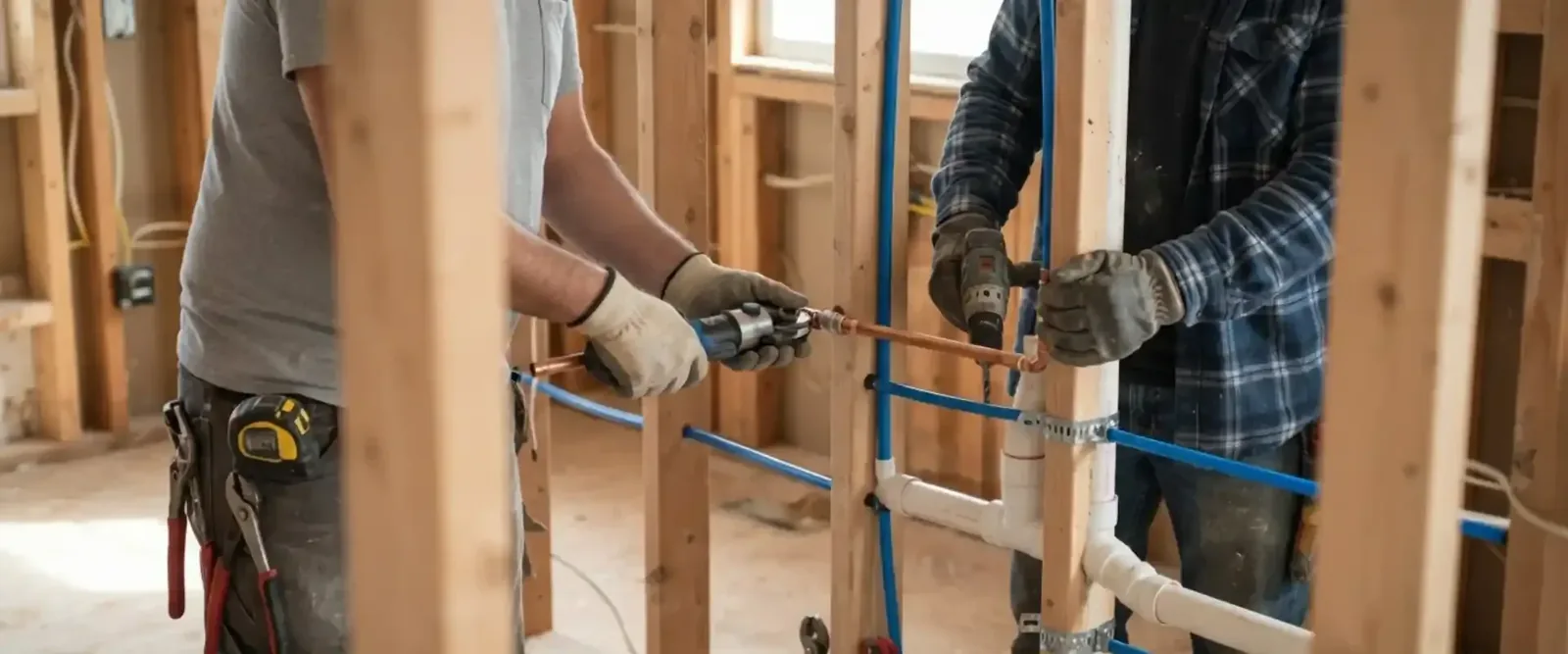
A bathroom job begins with the rough-in, which is the pipe work inside the walls and floor before drywall goes up. Supply lines run to the sink, tub or shower and toilet, and drain lines slope toward the stack with vents to let air in behind the water. The toilet flange sits at a set distance from the wall, and the shower valve is set at the depth the tile will need.
After the walls close, trim-out sets the fixtures: toilet, vanity faucet, shower trim and tub spout. Each connection gets a pressure and flow test. If the toilet is the main project, the details are on the toilet repair and installation page, and faucet swaps are covered under faucet repair.
Kitchen sink, dishwasher and laundry hookups
A kitchen needs hot and cold supply stops, a trap with a slope to the wall drain, and a high loop or air gap on the dishwasher drain hose to stop dirty water flowing backward. A garbage disposal adds a power connection and a drain port knockout. Laundry hookups need a standpipe at the right height, a trap and supply valves, with a pan or drain where the room sits over finished space.
Moving a sink to a new wall is where cost climbs, since drains must keep their slope and vent connection. Ice maker lines and pot fillers are small adds when the walls are open.
Planning a remodel or a new bathroom?
Call (855) 575-2890 and a dispatcher will set up a visit with a licensed plumber to look at the space.
Planning before you book: what to decide and what to have ready
- Decide fixture locations and model numbers, since rough-in depends on them
- Find your main shutoff and note whether the home is on public sewer or septic
- Check with the City of Stow Building Department about the permit before work starts
- Clear access to the basement, crawl space or wall where lines will run
- Choose a time when water can be off for part of the day
A quick way to tell public sewer from septic is the mail. Summit County bills public sewer customers quarterly, so a home that receives that bill is usually on public sewer. A septic home has a tank and a leach field instead, and that changes where new drains can go.
New construction: rough-in, top-out and final
| Stage | What happens |
|---|---|
| Underground | Drains and sleeves set before the slab or footing is poured |
| Rough-in | Supply, drain and vent pipes run through framed walls |
| Top-out | Vent stacks go through the roof and the system is tested |
| Inspection | The city plumbing inspection before walls close |
| Final | Fixtures set, tested and signed off |
Each stage ends with a test, usually water or air held in the pipes, and an inspection before the next trade closes the walls. Contractors schedule these around the Monday, Wednesday and Thursday morning inspection days. Commercial jobs usually need an on-site look first, so the scope and the permit path are clear before pipe is ordered.
Pipe choices: PEX, copper and PVC
PEX supply makes sense when
- Running long lines through finished walls
- Freeze resilience matters in an unheated space
- The budget favors fewer fittings and faster work
Copper makes sense when
- Exposed runs need a rigid, tidy look
- Matching existing copper in an older home
- The lines are near high heat
For drains, PVC is the usual plastic for waste and vent lines in newer work, and cast iron still turns up in older houses where noise matters. Mixing materials needs the right transition couplings. Homes from the late 1970s to the mid 1990s often have polybutylene supply pipe, a gray or blue plastic that was later phased out, so a plumber looks at what you have before tying into it.
Moving or adding lines to an existing home
Adding a bathroom or relocating a laundry takes a look at the drain slope, the vent path and where the line will meet your existing pipes. Basement bathrooms may need an ejector pit if the fixtures sit below the sewer line. If your project involves a water heater, see water heater installation for that piece.
Gas lines: leave first, call second
If you smell gas, leave the building right away. Call 911 or the gas utility from a safe place outside, and do not use light switches or phones inside. Call a plumber only after that, and understand that we make no promise about gas response times.
Gas line inspection and installation must be done by qualified, licensed trades. A plumber can tell you what is needed, and ask the City of Stow Building Department about permits before work starts.
Homeowners' insurance usually does not pay for upgrades. The plumber explains the price before work begins.
QuestionsBefore you start: installation questions
Stow's Building Code and Permits page lists plumbing systems among the work that needs a building permit. Rules vary by job, so ask the City of Stow Building Department before work starts.
Plumbing inspections are held Monday, Wednesday and Thursday mornings. Same-day requests must be called in before 9 am.
Not the city. Sanitary sewer permits go through the Summit County Department of Sanitary Services in Akron.
Leave the building and call 911 or the gas utility from outside. Do not use switches or phones inside. Call a plumber only after you are safe.
Neither wins everywhere. PEX is quick to run and handles freezing well, while copper suits exposed and high-heat runs.
Yes, once the plumber checks the slope to the sewer line. Fixtures below that line may need an ejector pit.