
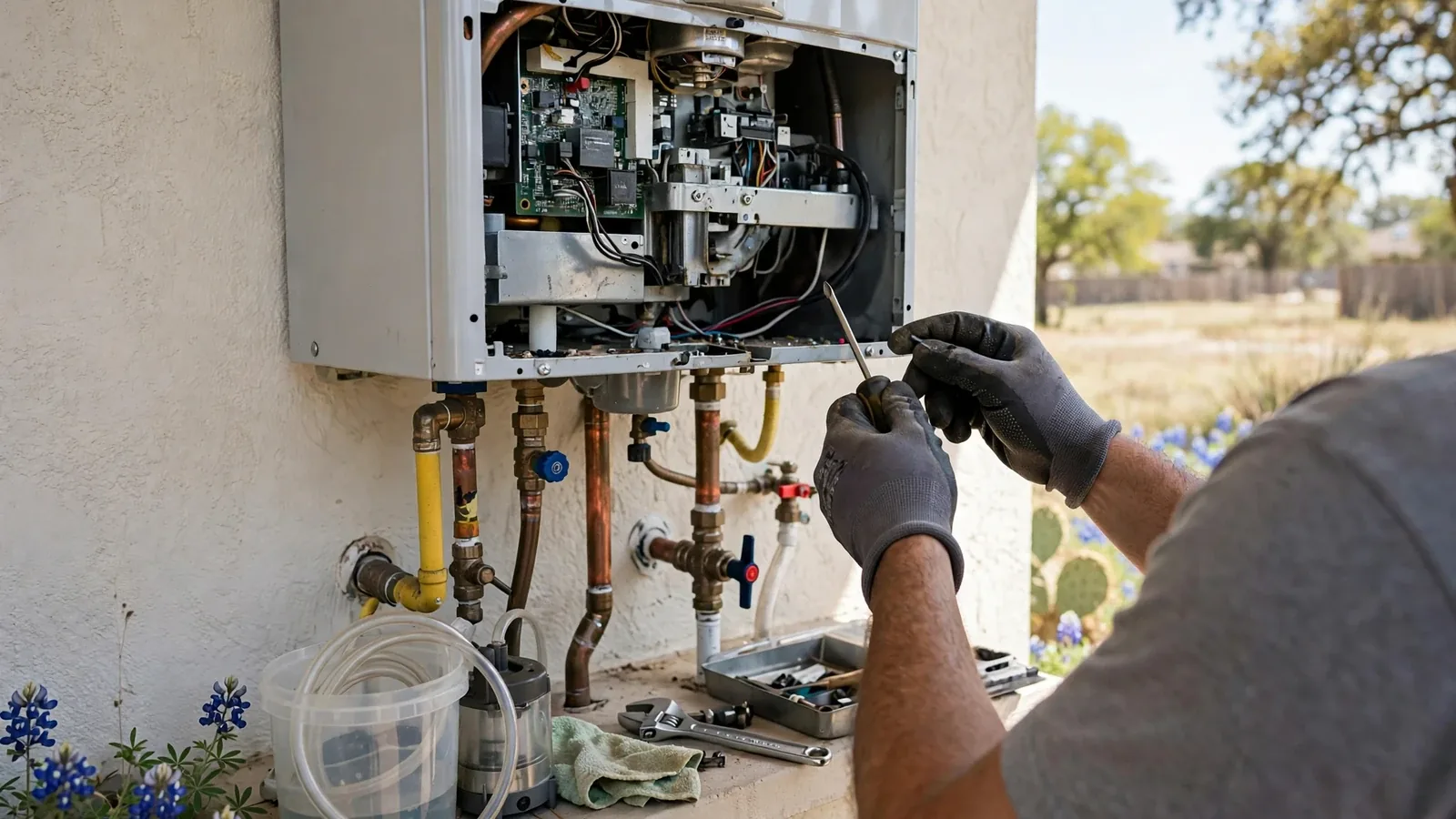
The pieces that make up the total
Think of the job as five line items. The unit is the first, and sizing it by flow rate and temperature rise is what decides which model you need. The other four are the gas supply, the exhaust and intake venting, the water-side fittings, and the labor to tie it all together.
Most surprises come from the second and third items. A tank heater sits on an existing gas branch and vents up an existing flue, while a tankless unit asks for more of both.
Why a tankless install costs more than a tank swap
A tankless unit fires a much larger burner for a short time, so it needs a bigger flow of gas than a tank heater. If the existing gas line is a small diameter, it often has to be upsized from the meter side, and that adds pipe, fittings, and hours.
Venting is the other driver. Most tankless models use stainless steel or approved plastic vent pipe with specific clearances, and a long run to an outside wall costs more than a short one. Condensing models also need a drain for acidic condensate, sometimes with a neutralizer.
Your homeowner's insurance does not usually pay for planned upgrades, and utility rebates, if any, change from year to year. Ask your plumber for a written breakdown so you can compare it line by line.
How to get a clear price, step by step
Note what you have now
Write down the current heater type, its location, the gas pipe size if visible, and how many bathrooms and big water users you have.
Decide on capacity
Count the fixtures that run at once. Hot water for a dishwasher and a shower at the same time sets the size more than the number of bedrooms.
Have the gas line checked
Ask the plumber to measure the run from the meter and check the pipe diameter against the unit's input rating.
Plan the vent path
Pick the exit wall or roof spot together, then confirm clearances from windows and meters.
| Item | Tank swap | Tankless install |
|---|---|---|
| Unit cost | Lower | Higher |
| Gas line | Usually reused | Often upsized |
| Venting | Existing flue often works | New vent pipe, set clearances |
| Water connections | Basic | Valves with flush ports advised |
| Upkeep | Occasional tank flush | Yearly descaling flush |
| Space | Floor footprint | Wall-mounted |
When to call a plumber
Call before you buy a unit online. A model that looks like a bargain can become expensive if the gas line or vent route does not fit it. A plumber who sees the space can tell you what the job needs before money is spent.
For an install plan, a water heater installation visit is the first step, and tankless water heater service covers the unit itself.
Planning a switch to tankless?
Call (855) 575-2890 and a dispatcher will arrange a licensed plumber to look at the gas line and vent path. The line is open 24/7.
Cost mistakes to avoid
- Buying a unit sized only by bedroom count, then finding it cannot feed two showers at once.
- Choosing the cheapest bid without checking that gas and vent work is included.
- Skipping isolation valves, which makes the yearly flush harder and costlier.
- Forgetting the condensate drain on a condensing model.
- Assuming an old flue can be reused without a plumber confirming it.
Ongoing costs after the install
Tankless units use gas only when hot water is running, which cuts standby losses from a heated tank. The saving depends on how much hot water your household uses, so do not expect the same result in every home.
Maintenance matters more with a tankless unit. Annual flushing keeps the heat exchanger clear, and neglected scale shortens its life. Neighbors in Kent and Munroe Falls face the same maintenance schedule.
Stow rules and water that affect cost
The City of Stow's pages list plumbing systems as work that needs a building permit, but they do not state water heater rules. Permit needs vary by job, so ask the City of Stow Building Department before work starts. Plumbing inspections are held on certain mornings, which can shape scheduling.
Stow's 2024 water quality report lists hardness at about 7 grains per gallon on average, which is moderately hard. That means flushing costs over the life of the unit are real, and you may want a flush-port valve kit and a filter or softener discussion with your plumber.
Cost questions about gas tankless heaters
Maybe not. Tankless burners draw more gas than a tank heater, so the pipe diameter and run length from the meter have to be checked against the unit's rating. A plumber can measure it on site and tell you if an upgrade is needed.
Often the units differ in capacity or efficiency, or one bid includes gas and vent work that the other leaves out. Ask each plumber to list the same line items.
Not always. It avoids standby heat loss, but the saving depends on your hot water use. A small household may see little difference.
Permit rules vary by job, and the city's pages do not state water heater rules. Ask the City of Stow Building Department before work starts.
Scale is a real concern with moderately hard water, and softening or filtering can reduce it. Discuss it with your plumber, because it adds equipment and upkeep of its own.
That is a different job with different electrical demands. This guide covers gas models only.
Place the unit and its condensate line where they will not freeze. A plumber can route both inside conditioned space or protect them.