
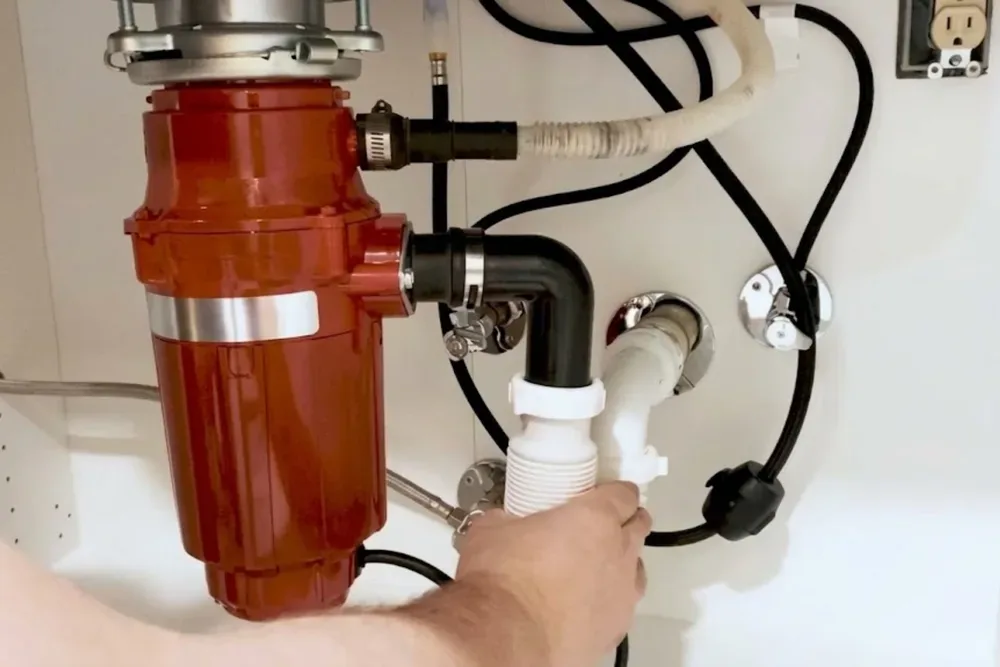
How a disposal fits under the sink
A disposal hangs from the sink drain opening. A metal flange sits in the sink hole, a mounting ring and snap ring lock the unit to it, and plumber's putty seals the flange against the sink. The grinder body then drops into place, and its discharge port connects to the trap with a short elbow pipe.
Inside, a motor spins a plate with lugs that push scraps against a grind ring. It does not use blades like a blender. Water carries the fine paste into the drain, which is why you run cold water while it works and for a few seconds after.
Motors come in rough size classes from one-third horsepower up to one horsepower. A bigger motor handles tougher scraps and runs a bit quieter, but it also weighs more and needs more room below the sink.
Choosing the right unit for your kitchen
Continuous-feed models run while the wall switch is on and you feed scraps by hand. Batch-feed models only run when a stopper lid is twisted into place, which suits households with small children. Both do the same grinding. The difference is how the unit is switched on.
Mounting style matters in a cramped cabinet. Some units use a three-bolt mount that is quick to install, while others use a more rigid mount for heavier models. A tall unit may collide with the trap or a water filter on the same cabinet floor, so measure down from the sink bottom before you order.
| Situation under your sink | What it means for the job |
|---|---|
| Replacing an old disposal | Often the quickest case: reuse the outlet and drain, swap the flange or mount |
| No disposal today, outlet nearby | New flange, new discharge pipe, and a switch check |
| No disposal, no power near the sink | An electrician may need to run a circuit before the plumber can finish |
| Dishwasher drains into the sink | Knockout plug removed from the new unit, hose clamped to the inlet |
| Double bowl sink | Drain tailpiece and trap arm usually need rearranging |
| Stainless sink with thin bowl | Flange fit and sink strength need a look before mounting |
If your current setup falls near the bottom of that table, the install can still be done in one visit in many kitchens, but it deserves a look before parts are bought. Our general plumbing installation work covers the sink drain and supply side, and the electrical side stays with a qualified electrician where a new circuit is needed.
A prep checklist before install day
- Clear the cabinet under the sink and lay down a towel or a shallow tray.
- Find out whether the disposal will plug in or be wired, and look for a wall switch or a switched outlet.
- Check that the shutoff valves under the sink turn. Stuck valves are common on older homes.
- Note whether a dishwasher drain hose connects to the sink or to the old disposal.
- Keep the manual, the mounting hardware and the power cord or wiring kit in one place.
- Tell the dispatcher about any slow drain, since a clogged trap changes the plan.
Common mistakes with new disposals
The first one is forgetting the dishwasher knockout. Many units ship with a thin plug inside the dishwasher inlet. If it stays in place, the dishwasher cannot drain, and you find out when the first load leaves a pool at the bottom. The plug needs to be punched out and removed from the unit before the hose goes on.
The second is overtightening the flange. Cranking the mounting screws squeezes the putty out unevenly and can crack a thin sink or leave a slow weep. The third is a poor trap slope, which lets food paste settle in a low spot and clog the line within weeks.
Want a clear price before the work starts?
Describe your sink and what is under it when you call. A dispatcher takes the details and arranges a licensed plumber, with same-day appointments when available. Call (855) 575-2890.
What a disposal should never see
Grease is the biggest enemy. It leaves the disposal as a warm liquid, then cools and coats the drain walls farther down. Fibrous scraps such as celery, corn husks and onion skins wrap around the grinding plate and slow it down. Coffee grounds, eggshells and starchy foods like pasta and rice pack into a dense paste in a trap.
A disposal also does not replace a trash can. If the drain is already slow, drain cleaning should come first, because grinding more food into a partly blocked line only makes the problem worse.
Stow permits, county sewer and what goes down the drain
The City of Stow's building code and permits page lists Plumbing Systems among the work that needs a building permit, and it does not mention disposals by name. Permit rules vary by job, so ask the City of Stow Building Department before work starts. Its main line is 330-689-2729.
Disposals feed the Summit County sewer system, since the City of Stow does not provide sanitary sewer service. Summit County's sewer backup page says backups caused by private lateral obstructions or non-flushable items are not a justifiable claim. Keeping grease and fibrous waste out of the line is the simplest way to avoid that problem.
What you can do and when to call a plumber
A handy homeowner can swap an existing disposal for a similar one if the shutoff valves and outlet are in good shape. That job mostly involves removing the old unit's mount, hanging the new one and reconnecting two hoses. Turn off power at the breaker before touching any wiring.
Call a plumber when a flange needs to be cut into a sink for the first time, when the drain pieces do not line up, when the cabinet shows water damage, or when you are not sure the power is safe. If the disposal you already own hums, jams or leaks, a garbage disposal repair or replacement visit is a better starting point than buying a unit and hoping it fits.
Homeowners in Tallmadge and Kent ask the same questions before a first disposal install, and the answer depends on what is under the sink, not on the town.
QuestionsGarbage disposal installation questions from Stow homeowners
A straight swap can be quick, while a first-time install takes longer because the flange, discharge pipe and power all have to be set up. Time depends on the sink, the cabinet and whether an electrician is needed.
Most standard 3.5 inch drain openings accept one. Very thin stainless sinks and some composite or fireclay sinks need a closer look, because the flange clamps hard against the material.
If the dishwasher drains through the disposal, the hose connects to a side inlet on the unit. The knockout plug has to come out first. A plumber checks the hose loop and clamp so the dishwasher drains cleanly.
No. The bill follows water use read from the city meter. The City of Stow sends meter reads to Summit County monthly, and the county bills quarterly. A disposal does not change the read, though it does add some load to the line.
Not when used with cold water and the right scraps. Problems start with grease, fibrous waste and too many scraps at once. Older cast iron or clay drains in some Stow homes are less forgiving of heavy food waste.
Cold. Cold water keeps fats solid so the grinder can chop them and flush them as small bits. Hot water melts grease, which then re-solidifies farther down the drain.
Leaks at the flange usually mean the putty seal or mounting ring needs resetting. A hum with no spin is a jam, and many units have a hex socket on the bottom to turn the plate by hand. If it keeps happening, call for a visit.