Why a lower setting is the usual advice
Water much hotter than 120 degrees can scald skin in a short time. Young children and older adults burn faster than healthy adults, and a quick turn of a lever is enough for a bad moment. Setting the heater to about 120 keeps the water hot enough for daily use while lowering that risk.
A lower setting also saves energy, since the burner or elements work less hard. And it cuts scale. Scale forms faster as water temperature rises, so a hot setting accelerates buildup on the heat exchanger inside a tankless unit.
How a tankless heater sets its temperature
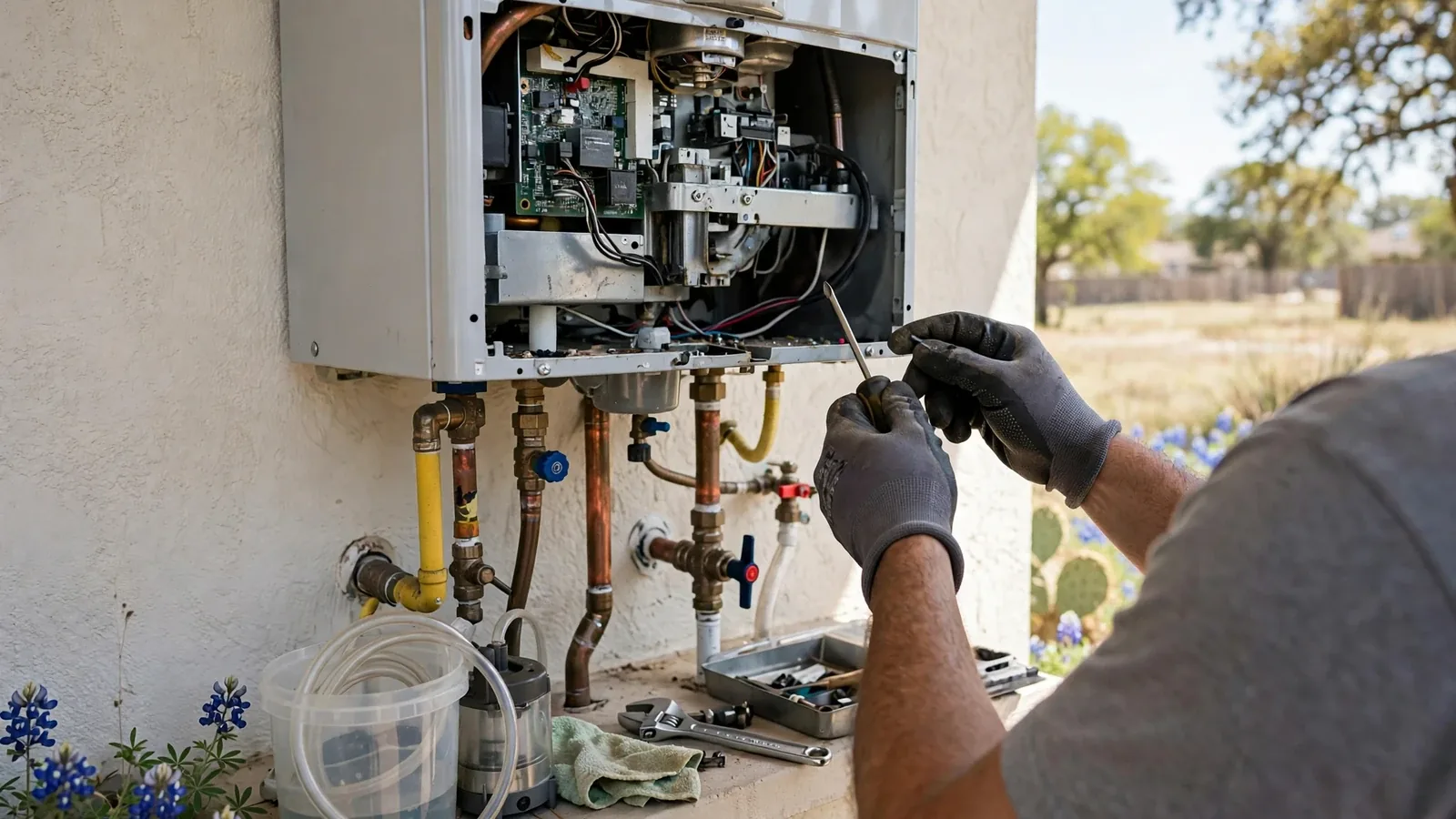
A tankless unit has no tank to hold hot water. When you open a hot tap, flow through the unit triggers a burner or heating element. A sensor reads the outgoing water, and a controller adjusts the heat to match the setpoint you chose.
That means the number you pick is the target for the water leaving the unit. Water at the faucet can be a few degrees cooler after traveling through pipes, especially in a long run. Flow rate matters too: if you open many taps at once, the unit may not keep up and the temperature will drop.
| Control type | What you see | How to adjust |
|---|---|---|
| Dial on the unit | A turn knob with marks or a range of numbers | Turn to the mark near 120 and wait for the next hot draw |
| Buttons and display | A screen showing a setpoint number | Press up or down until the setpoint reads about 120 |
| Wall remote controller | A numbered display near the unit or in the house | Use the remote's arrows, then confirm the setting |
| DIP switches inside | Small switches that set a range | Follow the manual, since combinations differ by model |
| App or smart control | A phone screen showing the setpoint | Set the target in the app and check it at a tap |
Some units show a setpoint in degrees, while others show only low, medium and high. If yours has no number, use a kitchen thermometer to check the water after it has run for a minute, and adjust until it lands near 120. A few models also lock the setting or cap the maximum, which is useful when children are in the house.
A short checklist for checking your setting
- Read the manual or the label on the unit before changing anything.
- Note the current setpoint in case you want to go back.
- Change the setting by small steps and wait for a fresh hot draw each time.
- Test the water at the tap with a thermometer, running it for about a minute.
- Look at the display for error codes after the change, and write down any that appear.
- Keep the manual where you can find it, near the unit if possible.
Common mistakes with tankless settings
The most common one is turning the heater up to fix a weak shower. If the shower is lukewarm because the unit cannot keep up with flow, a higher setpoint rarely helps and it adds scald risk. A clogged inlet screen, a scaled heat exchanger or a mixing issue in a single-handle valve is a likelier cause.
Another is setting the unit very high and relying on a mixing valve to temper it. That works only when the valve is installed and working. A third is forgetting that a recirculation pump or a second heater in the house runs on its own setting.
Stow's moderately hard water and your setting
According to the City of Stow's 2024 water quality report, the water averages about 7 grains per gallon in hardness. That is moderately hard, and it leaves scale on heat exchangers, heating elements and faucet aerators. Scale forms faster as water gets hotter, so a modest setting around 120 gives your unit an easier life.
Scale does not mean a unit has failed. It means a descaling flush is worth scheduling, often once a year, though the manual has the right interval. If hot water output has dropped and the display shows an error, that is often scale restricting flow. A tankless water heater service visit can flush the heat exchanger and check the inlet filter.
When to call a plumber
Call if the water never gets hot, if it swings between hot and cold, if the display shows a repeated error code, or if you smell gas near the unit. If you smell gas, leave the building, call 911 or the gas utility from outside, and do not use switches or phones inside.
For performance problems, a water heater repair visit can check the flow sensor, the inlet screen, the venting and the heat exchanger. Homeowners in Hudson and Tallmadge run into the same settings questions, and the answer follows the model, not the town.
Hot water acting up?
Tell the dispatcher what the display shows and when the problem started. A licensed plumber is arranged, with same-day appointments when available. Our 24/7 line is open at (855) 575-2890.
Tankless water heater temperature questions
About 120 degrees Fahrenheit is the commonly recommended household setting. It balances comfort, scald safety and scale control. Follow your manual for how to set it on your model.
Many units go higher, and some households need that for a dishwasher without a booster or a specific appliance. A higher setting raises scald risk and speeds scale. Consider a mixing valve if you need hotter water at the unit.
Flow is often the reason. Too many taps open, a clogged inlet screen or scale in the heat exchanger can cut output. A long pipe run also cools the water before it reaches the faucet.
The setting stays near 120 for safety, but hardness changes upkeep. The city's 2024 report gives about 7 grains per gallon on average, which is moderately hard, so scale builds up over time and a flush schedule matters. Hotter settings speed that buildup.
Check the display, dial or app. If there is no number, fill a cup at the tap after running it a minute and read it with a thermometer.
The 120 degree guidance focuses on scalds. If anyone in the house has a health concern about stored hot water, ask a doctor or the manufacturer. Tankless units hold little water, which is part of their design.
A tankless unit uses little energy when idle, so there is less to gain than with a tank. For a long winter trip, follow the manual on freeze protection instead.