
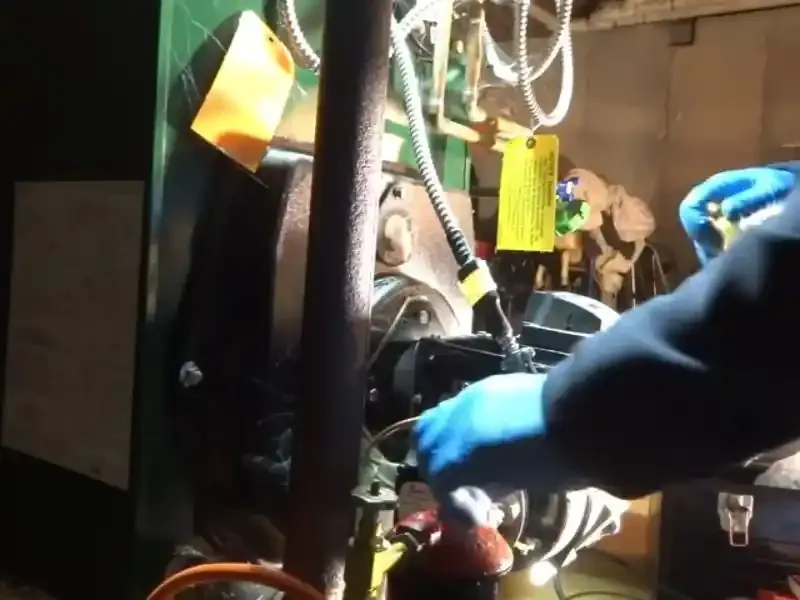
What a boiler does and why it stops
A boiler heats water in a sealed steel or cast iron vessel. A pump sends that hot water through pipes to baseboard fin-tube, radiators or in-floor tubing, and it returns cooler to be heated again. Steam systems work on the same idea, but the water is boiled and the steam rises on its own pressure.
Because the system is closed, it needs the right water pressure, a working circulator pump, clean heat-exchange surfaces and a burner that lights on command. If any one of those drops out, the house goes cold.
Why boilers fail in Northeast Ohio homes
Heating season here is long, with freeze and thaw cycles that stress piping and test every part of the system. A boiler that sat idle all summer often shows its weak points on the first cold night: a seized circulator, a stuck zone valve, a dead ignition part.
Age matters too. Older Census data puts the median year Stow homes were built at 1980, with about 32% built from 1960 to 1979 and about 18% before 1960. Homes from this era often have older hydronic systems, and iron radiators or original piping can be decades old. Newer boilers in these homes may be paired with old distribution pipes that develop leaks.
No heat at all
Check the thermostat, the power switch at the boiler and the breaker. A lockout or a tripped limit can look the same as a dead unit.
Low pressure
A pressure gauge that has dropped near zero often means a leak or a failed expansion tank. The pressure should be steady when the system is cold.
Banging or gurgling
Air in the lines, a failing pump or sediment in the heat exchanger can all make noise. Bleeding air from radiators helps in the first case.
Cold spots
One radiator or zone staying cool points to trapped air, a stuck zone valve or a blockage rather than the boiler itself.
Water around the boiler
Drips at a relief valve, a pump flange or a fitting call for attention soon. A slow leak can ruin controls below it.
Short cycling
A boiler that starts and stops repeatedly is often oversized for the load or has a failing sensor or low water condition.
Safe steps to try before you call
Check the thermostat
Set it to heat and a few degrees above room temperature. Replace the batteries if it has them.
Check power and the switch
Make sure the emergency switch near the boiler is on and the breaker has not tripped. Reset a breaker once only.
Read the pressure gauge
Note the number on the gauge when the system is cold, and write it down. Do not add water unless the manual shows how.
Look for leaks
Check around the boiler, pipes and nearby floor. A wet floor or visible rust staining is worth a photo for the plumber.
Do not remove covers, adjust gas valves or bypass safety controls. Those parts protect your home. If you find water around the unit, a leak detection visit can trace slow leaks in hidden piping, which is common in basement slabs and walls.
| Situation | Usual direction |
|---|---|
| Failed pump, valve or thermostat | Repair, since these are common parts |
| Cracked heat exchanger | Often replacement |
| Frequent repairs on an older boiler | Compare repair costs with replacement |
| Leaking radiator valve or fitting | Repair |
| Boiler with heavy corrosion at the base | Replacement is likely |
When to call a plumber right away
Call now for water pooling around the boiler, a relief valve that keeps discharging, no heat during a hard freeze, or any burner behavior that looks wrong such as yellow flames or soot. A frozen pipe with no heat can burst, and a burst pipe is a second emergency on top of the first.
If a carbon monoxide detector sounds, treat it as real. Get everyone outside and call 911. For other boiler problems, boiler repair is available on our 24/7 line, and a dispatcher takes your address and arranges a licensed plumber.
Boiler down in cold weather?
Tell the dispatcher what the gauge reads and what the boiler is doing. A licensed plumber is arranged, with same-day appointments when available. Call (855) 575-2890.
Heating a Stow home through winter
Northeast Ohio winters bring freeze and thaw cycles, so a heating failure can threaten pipes as well as comfort. If your boiler quits, keep the house as warm as you can, open cabinet doors under sinks on exterior walls, and let a faucet drip if a pipe is at risk of freezing.
Because most Stow homes date from the 1960s through the 1990s according to older Census data, many boilers and distribution systems here are on the older side. If yours has been repaired more than once, ask the plumber about the remaining life of the heat exchanger and the pipes.
For plumbing work tied to a boiler, ask the City of Stow Building Department whether a permit is needed. The city lists Plumbing Systems among work that needs a building permit, and permit rules vary by job. Homeowners in Cuyahoga Falls and Kent face the same winter, so the same advice applies.
Boiler repair questions from Stow homeowners
If you smell gas or a carbon monoxide alarm sounds, leave and call 911 or the gas utility from outside. For a boiler that simply will not run, call a plumber, since boilers are water systems. Our 24/7 line takes the address and arranges a licensed plumber.
A slow leak, a worn relief valve or a failed expansion tank are common reasons. Water on the floor or rust around fittings is a clue. A plumber can test the system and find the source.
Often yes, with a radiator key and a cup. Close the valve when water appears. If pressure drops afterward, the boiler may need water added by following the manual or by a plumber.
Air, scale or a failing circulator pump is the usual cause. Steam systems can also bang from pitched pipes that hold water. A visit can sort out which it is.
Once a year before heating season is the common advice. Service lets a plumber test the controls, check the pump and look for leaks while it is not an emergency.
Yes. A slow leak can soak flooring, damage controls and corrode the boiler base. If you see damp spots, get it checked early.
Repair is usually cheaper today, replacement can be cheaper over several years for an old, failing unit. A plumber can give a clear price for each so you can compare.